
WATER WELL
Water, the foundation of civilization and life, is the most basic necessity for all living beings on Earth.
However, in many parts of Africa, access to clean drinking water remains a major issue, and every day millions of people walk kilometers to fetch water from the nearest well for their homes.
Moreover, due to scarcity of usable water, polluted water, drought, and inadequate infrastructure, thousands of people lose their lives to diseases such as cholera, typhoid, dysentery, and pneumonia.
With the wells we establish, people can meet their basic needs, protect their health, and even provide water for their animals, ensuring their survival as well.
It shouldn’t be too difficult to empathize with people whose lives are spent battling thirst. Although it may be hard to imagine from the comfort of our warm homes, let’s try: When you open your eyes, you wake up in a makeshift shack. You are under a roof, but it doesn’t feel like a real home; the temperature is the same in every season, and you cannot get a comfortable night’s sleep.
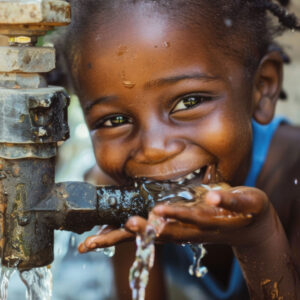
There is no glass of clean water by your bedside anymore. You also don’t have the luxury of a shower to prepare for the day as soon as you wake up. Soon, you will walk kilometers to reach muddy rainwater. And when you set out with the hope of a single drop of rainwater, you forget about its contamination. Because you live in a place where you see animals that have died from drought and thirst along the roads. You even meet your hygiene needs with that not-so-clean water, because there is no other option.
You wash your clothes in dirty water, and even cleanse yourself in the same water. Alongside that water, which is far too contaminated to drink, you dream of a single drop of clean water. Yet, amid these thoughts, you receive news of your loved ones who fell ill and lost their lives from the dirty water.
As the Hilful Fudul Foundation, we do not remain indifferent to the suffering in these regions. Together with our donors who share our vision, we continue our services in oppressed areas by establishing water wells.
By sharing the blessings that God has given us, we aim to ensure that no child becomes orphaned after losing parents to illnesses caused by dirty water, that no mother loses her child to thirst, and that no animal dies from lack of water. This is why we work with all our strength to bring water to these lands. Our greatest desire is to achieve many good deeds together with our donors who share this mission with us.
On this occasion, you can have a water well established in one of the countries where we carry out our work and name it after yourself. Donors who wish can personally attend the opening of the wells and witness the joy their contributions bring to the region. For donors who cannot attend the opening in person, we provide videos and photos so they can see the happiness created by their charitable act.
For philanthropists who cannot fund a water well on their own, you can participate in our pooled system according to your capacity to contribute.
For more detailed information about the project and to provide support, you can contact us via email at hilfulfudulvakfi@gmail.com or call our hotline at 05363295739.
The Virtue of Establishing a Water Well
Establishing a water well in Africa provides significant assistance to people struggling with many issues such as drought and poverty. Water scarcity and diseases caused by contaminated water are among the greatest challenges faced by people in Africa and can even lead to death. Therefore, establishing water wells to alleviate these difficulties and prevent animals from dying of thirst is of great importance.
Establishing a water well not only meets a physical need but also carries a spiritual value. The importance of this is emphasized in the saying of Prophet Muhammad: “Whoever relieves the need of a Muslim brother, Allah will relieve their need. Whoever alleviates a hardship from a Muslim, Allah will ease one of their hardships on the Day of Judgment.” This hadith highlights the great significance of helping others and meeting their needs. Additionally, sources mention that a sinful woman attained Allah’s pleasure and was forgiven by giving water to a dog that was about to die of thirst on a hot day. [Muslim, Repentance 155, (2245)]
We find it beneficial to share another important hadith regarding providing water for humans and animals.
Sa’d b. Ubâde’s mother had passed away, and he came to the Messenger of Allah and asked, “O Messenger of Allah! My mother has died; can I give charity on her behalf?” The Prophet replied, “Yes.”
When Sa’d asked, “Which charity is more virtuous and valuable?” the Messenger of Allah replied, “It is to provide for the water needs of humans and animals.” (Nasa’i, Wasaya, 9; Ibn Majah, Adab, 8)
Another hadith on this subject states: “Whoever gives water to a thirsty Muslim, Allah will give them a drink from the Paradise beverage with its delightful fragrance.” (Tirmidhi, Qiyamah, 18; Abu Dawud, Zakat, 32)
In a narration listing deeds that continue to earn rewards for a believer even after death, “digging a canal to bring water” is also mentioned. (Ibn Majah)
Questions and Answers About Water Wells
Are the wells that are established monitored afterwards?
Since we carry out continuous work in the regions where we establish wells, we have the opportunity to monitor the wells and carry out repairs, maintenance, and restoration.
Are the water wells established only in Muslim countries?
The Hilful Fudul Foundation provides aid in its charitable activities without discrimination based on religion, language, race, or gender. Our priority is to reach and help those in need wherever they are. However, in many cases, people in need living in war-torn or occupied regions are predominantly Muslims. In this sense, although the majority of the wells we establish are in areas inhabited by Muslims, we also build water wells in regions where people of other faiths live.
Can I name the wells that are to be established?
You can name a well by covering the cost of establishing it. For wells with taps, if you donate the share amount for a tap, you can name one tap after yourself.
Can I see the location where the water well will be established in advance?
Of course, you can view the region and the site before the water well is established.
Do you send a video of the water well once it is established?
A video of the established water well is sent to our donors.
Can I personally attend the opening of the water well?
Donors who wish can personally attend the opening of the water wells and witness the joy their contributions bring to the region. For donors who cannot attend in person, we provide videos and photos so they can see the happiness created by their charitable act.
What is the lifespan of the water wells?
The lifespan of water wells can vary depending on underground water reserves, climate changes, usage intensity, and external factors (such as war or natural disasters). Due to these factors, the standard lifespan of a water well is typically between 5 and 10 years.
What is the warranty period for the water wells established through your foundation?
The water wells are monitored and maintained by our foundation for a period of 5 years, after which the responsibility for the wells is transferred to the local community.
What are the technical specifications of the water wells?
Depth: Between 40 and 60 meters
Number of beneficiaries: 1,000–2,000
Surface construction: Concrete body, hand pump, animal trough (Standard water wells are mostly constructed using a hand pump and include an animal trough. The wells are built according to a standard surface concept. However, depending on the conditions of certain regions, a different surface concept and type of pump may be used.)
Does the Hilful Fudul Foundation include an organization fee in the pricing of water wells?
Every event incurs its own expenses. Our foundation collects an organization fee for each event at a specified rate to cover its own costs and other organizational expenses (such as water well monitoring, maintenance, repairs, spare parts supply, transportation, shipping, personnel hiring, etc.) and clearly informs its donors about this fee.

